
What the AI zombie trend actually is
Strip away the zombie make-up and it's a love story in two reels. Reel one is cold: a ruined, blue-gray world, a figure turning toward the camera, and you — gun up, hands shaking — realising it's someone you love. Reel two is warm: the exact same embrace, but now it's golden hour, they're alive, and the memories you shared play in slow motion.
People make it from ordinary photos of a partner, a parent, a best friend or a pet, using image-to-video AI models. The emotional payload comes from the familiar face inside the horror — that's why it only works with someone the viewer knows you love.
What it looks like
A real, unedited 12-second example made on aizombievideo.org from two photos (sample faces are AI-generated):
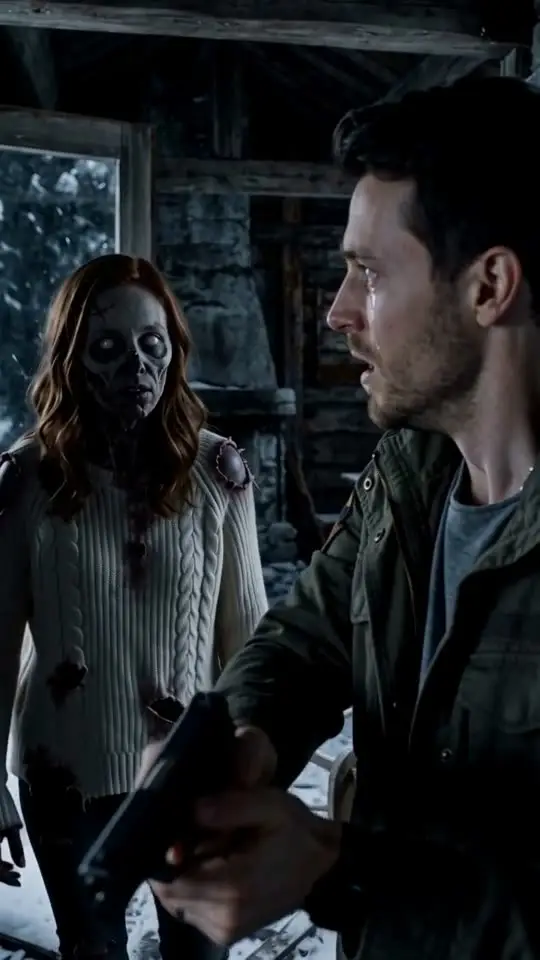
Zombie girlfriend · Snowed-In Cabin
Two photos (her + him) → he lowers the gun, she hugs him, hard cut to a sunny snowy slope.
The six beats every viral version uses
Watch ten of them back to back and the structure is almost identical:
- The standoff — A gray, ruined place — a cabin, a street, a supermarket. Someone you love stands there, but their skin is ashen and their eyes are clouded.
- The raised gun — You lift the gun. Your hands shake, tears are already running. The camera holds on your face, not the weapon.
- Recognition — Something familiar — a necklace, a collar tag, the way they tilt their head. You lower the gun.
- The hug — The zombie stumbles closer and, instead of biting, wraps its arms around you. You hold on.
- Hard cut to memory — Same pose, same hug — but now it is golden hour, a snowy slope or a flower meadow, and they are alive and laughing.
- Flashback reel — Two or three quick, warm memories in slow motion. End on their face, or cut back to the gray world for the gut-punch.
- R1 · 00:00
01The standoff
A gray, ruined place — a cabin, a street, a supermarket. Someone you love stands there, but their skin is ashen and their eyes are clouded.
- R1 · 00:02
02The raised gun
You lift the gun. Your hands shake, tears are already running. The camera holds on your face, not the weapon.
- R1 · 00:04
03Recognition
Something familiar — a necklace, a collar tag, the way they tilt their head. You lower the gun.
- R1 · 00:06
04The hug
The zombie stumbles closer and, instead of biting, wraps its arms around you. You hold on.
- R2 · 00:10
05Hard cut to memory
Same pose, same hug — but now it is golden hour, a snowy slope or a flower meadow, and they are alive and laughing.
- R2 · 00:16
06Flashback reel
Two or three quick, warm memories in slow motion. End on their face, or cut back to the gray world for the gut-punch.
Why it makes people cry
- A reversal you feel coming. The audience knows the zombie is the loved one before the character does — the tension is waiting for the gun to drop.
- The hard cut. Cold to warm in one frame, same pose, same hug. The brain reads it as a memory surfacing, not a scene change.
- Real faces. It's your partner, your dog, your mom. Fictional zombies are scary; familiar ones are heartbreaking.
- Grief, quietly. Many creators make it about a pet or parent who has died. The zombie is a way to say “I'd still choose you” without saying it.
The main variants
- Zombie girlfriend / boyfriend — The original couple version — the one that made the trend. Works best when both faces are in the photos.
- Zombie dog — The pet version that took over Russian- and Spanish-speaking TikTok. The collar tag is the recognition moment.
- Zombie cat — Smaller, slower and somehow sadder. Keep the zombie details subtle so the cat is still recognizable.
- Zombie mom / dad — A parent version. Pair a current photo with an old childhood photo for the flashback.
- Zombie dad — Same structure as the mom version. Old family photos make the flashback hit hardest.
- Zombie best friend — The friendship version — great for duos and siblings. Use a road-trip or concert memory.
Ready-made prompts for each one are in the Zombie Love Story prompt library, and the pet version has its own dog & cat guide.
Timeline
| When | What happened |
|---|---|
| 2025 – mid 2026 | AI “hug” videos — hugging your younger self, a late relative, a pet — become a staple on TikTok and Reels. |
| Mid 2026 | AI zombie short films (multi-minute Seedance and Veo shorts) show image-to-video models can hold a face through zombie make-up. |
| Late Sep 2026 | The two ideas merge: the zombie hug / zombie love story format and its Dreamina & CapCut tutorials spread across TikTok and Instagram. |
| Oct 2026 | Pet, parent and best-friend versions; tutorials appear in English, Indonesian, Russian and Spanish. Halloween season pushes it further. |
Sources
- TikTok tutorial describing the zombie hug trend (Dreamina)
- Mangidik — How to make viral AI zombie drama videos (Oct 2026)
- Apnotak — Zombie apocalypse AI video editing prompt
FAQ
When did the AI zombie trend start?
+
Tutorials and remakes started stacking up on TikTok and Instagram in late September 2026 and the format was everywhere by early October — right in time for Halloween season.
Why is it called the Zombie Love Story?
+
Because the horror is a set-up for a love story: the zombie is someone you love, you can't bring yourself to shoot, and the hug turns into warm memories of your life together.
Is the AI zombie trend scary?
+
Barely. The good versions avoid gore entirely — clouded eyes and gray skin are enough. The point is the emotional turn, not the jump scare.
Is it the same as the AI hug trend?
+
It grew out of it. AI hug videos (hugging your younger self, a late relative or a pet) were already popular; the zombie trend adds a horror set-up and a hard cut to memories.
Skip the prompts
Get your zombie love story made for you
Upload a photo of who turns, pick a world, get a 12-second video in minutes. From $9.99, no subscription.
Make my AI zombie video →